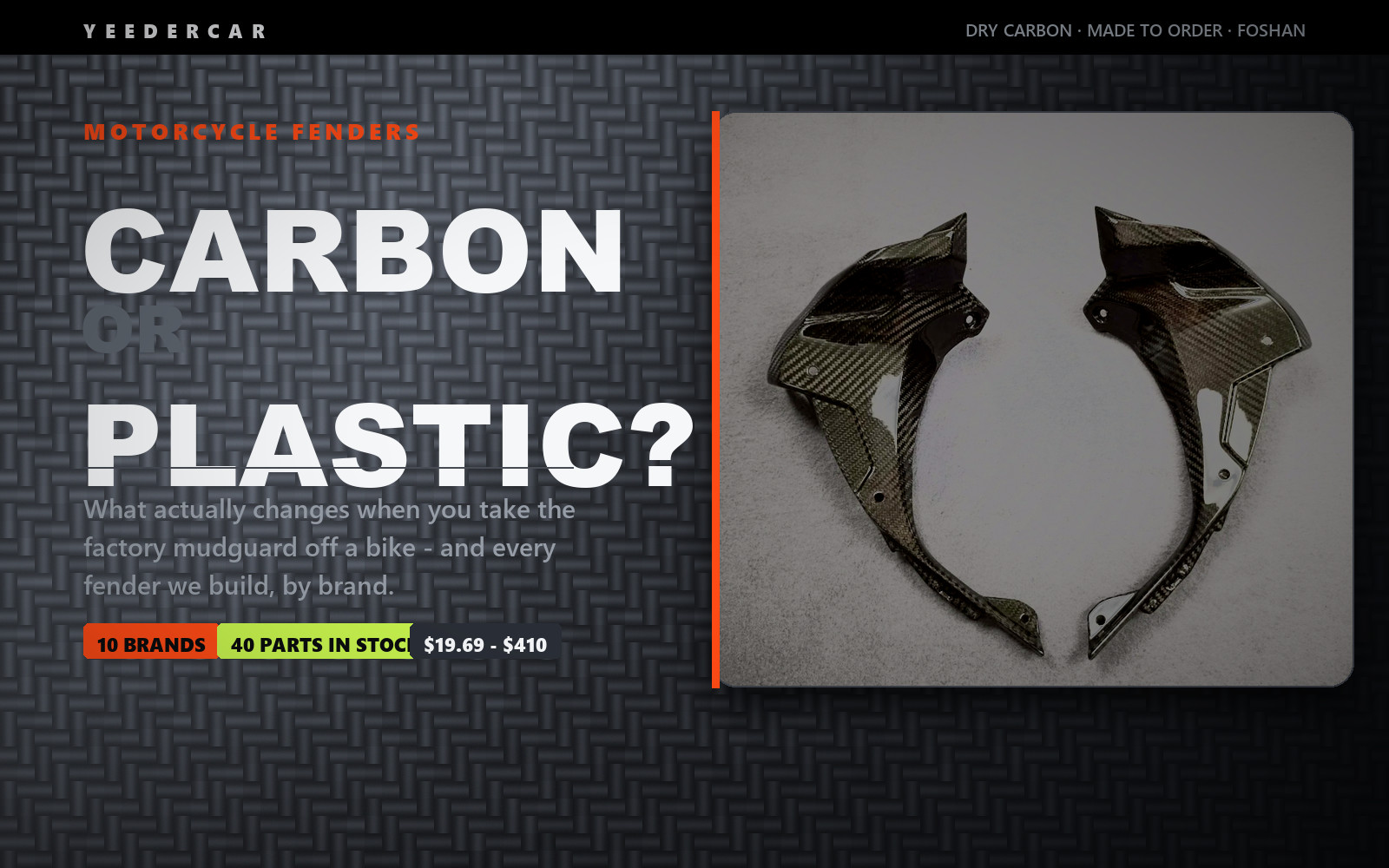
The front fender is the cheapest-looking part on a motorcycle and the one you look at every time you park. On most bikes it leaves the factory as a black or body-colour ABS moulding – and it is the first panel to go chalky, the first to buzz at speed, and on a few models the first to rust through, because it is steel rather than plastic.
We build forty of these panels. They cover ten brands, they run from $19.69 to $410, and they are all made on the same bench, one at a time, after you order. This page is the honest version of what changes when you swap one.
Start with what the factory part is actually made of, because the answer is not always “plastic”. The Kawasaki Versys 650 rear and mid fender we list is sold specifically as a replacement for a wing that has gone rusty – that panel is steel on the bike. Same story on the Honda NS125GU inner fender. On those bikes the upgrade is not cosmetic at all: the original part is a corrosion problem with a lifespan.
Where the factory part is ABS, the failure mode is different. It is light, but it is thin and it is not very stiff, so it moves in the arch. It softens with heat. And it is painted, which means every stone chip takes a piece of the finish with it and leaves pale grey plastic showing underneath.
- 3K 2×2Hand-laid twill – the standard layup, with 6K, plain weave and carbon-kevlar available.
- VacuumBagged and cured in our own autoclave, so the resin-to-fiber ratio stays consistent.
- Not filmReal carbon, under a UV clear coat. Not hydro-dipped, not printed, not a wrap.
| What you are comparing | Factory panel | Our carbon panel |
|---|---|---|
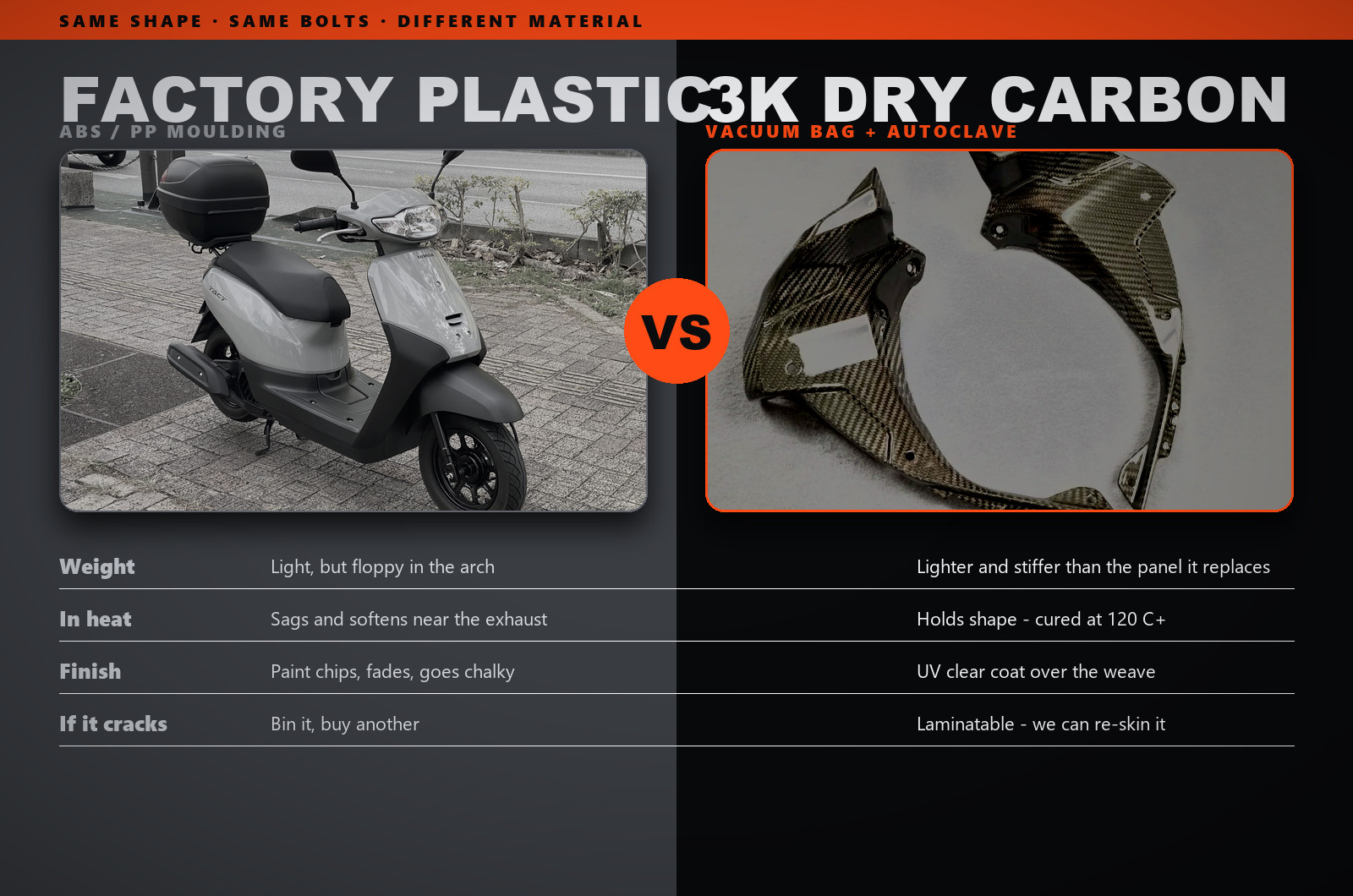
| Weight and stiffness | Plastic is light but floppy in the arch; steel wings are heavy | Lighter and stiffer than the panel it replaces |
| Heat | ABS softens, and can sag near an exhaust or under a track-day heat soak | Autoclave cured – it keeps its shape in heat |
| Finish over time | Paint chips, fades, and goes chalky | UV-stabilised clear coat over the weave, so it stays dark |
| Corrosion | Steel versions rust through at the mounts | Composite – nothing to corrode |
| If it is damaged | Replace it | Laminatable – we can re-skin a panel rather than scrap it |
Most of the price difference between our $64 Kawasaki front fender and our $410 Kawasaki rear fender is not the material – it is how much mould there is and how deep the part is. A shallow front fender drops out of a simple tool. A rear hugger wraps the shock, the linkage and the swingarm, and it has to clear a moving wheel at full compression.
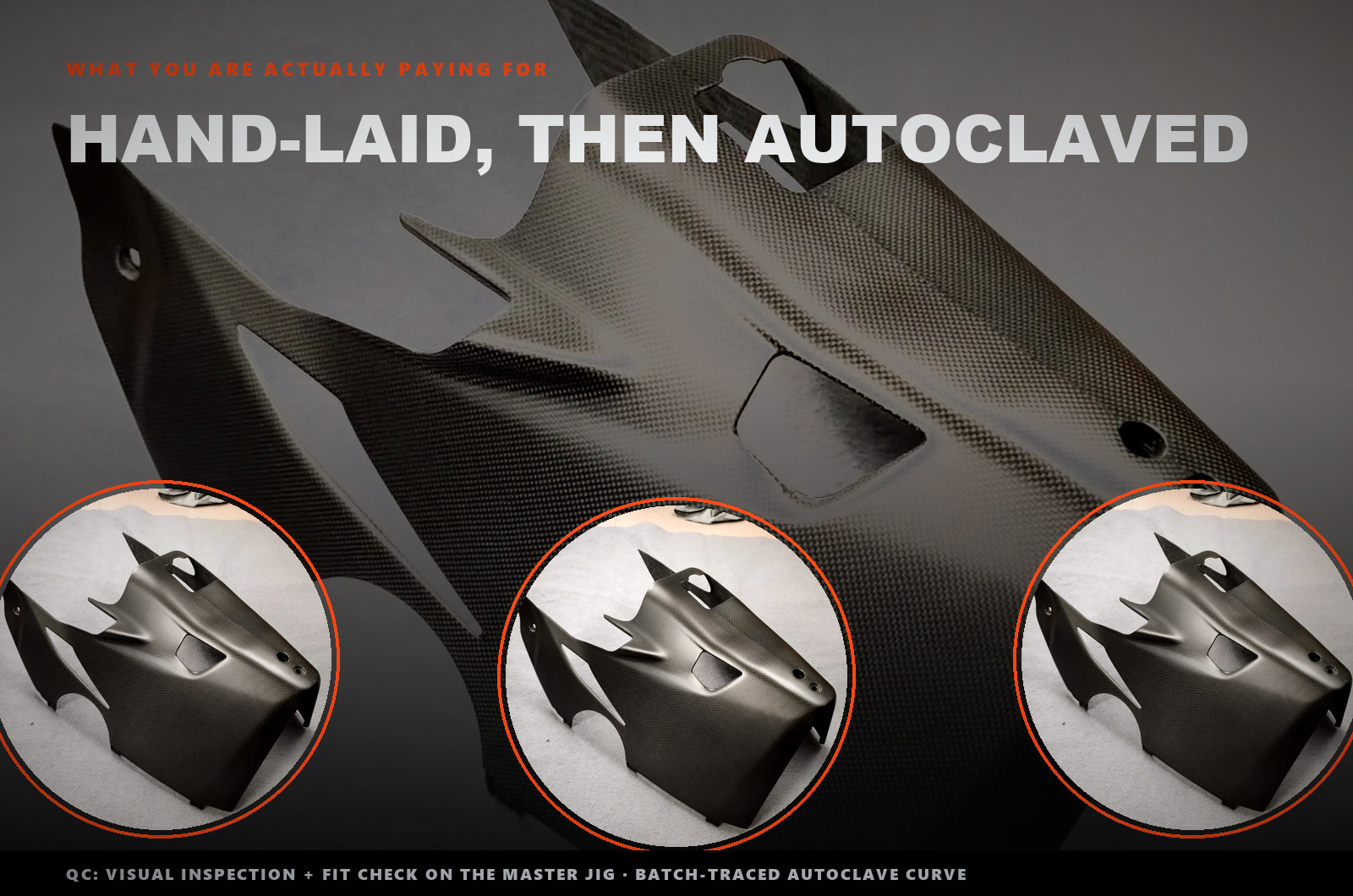
What does not change across the range is how the panels are made. Carbon cloth is laid into the mould by hand, vacuum bagged, and cured under heat and pressure in our autoclave, with the temperature and pressure curve logged so that a finished part can be traced back to its batch. Weave, weave direction and clear-coat finish are chosen when you order: gloss, matte, satin or forged carbon, in 3K twill, 6K twill, plain weave or a carbon-kevlar hybrid, with tinted clear coats in red, blue or yellow if you are matching a livery.
Which brings up the cheapest part in the range. Our BMW F900R and F900XR extender is $19.90, and it is listed as a carbon pattern extender – the name is doing exactly the job a name should do. It is a small cosmetic panel at a cosmetic price. Every other fender on this list is real carbon. Neither is a con; they are simply two different products, and the price tells you which one you are looking at.
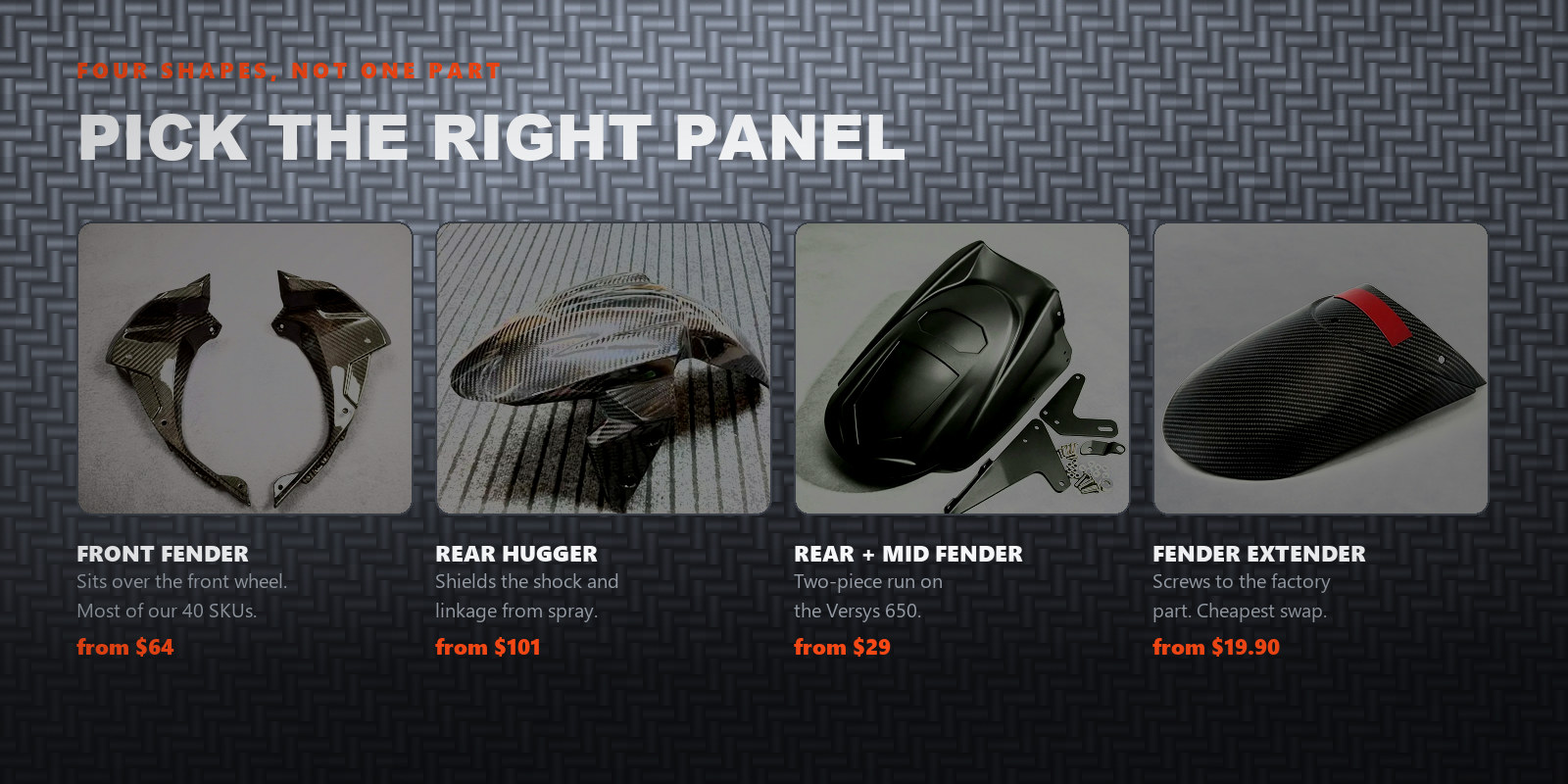
Forty fenders, ten brands, all in stock as made-to-order. Front fenders make up most of the list, but there are four genuinely different shapes in it – a front fender, a rear hugger that shields the shock and linkage, a two-piece rear and mid set for the Versys 650, and a screw-on extender for bikes whose factory part is nearly right.
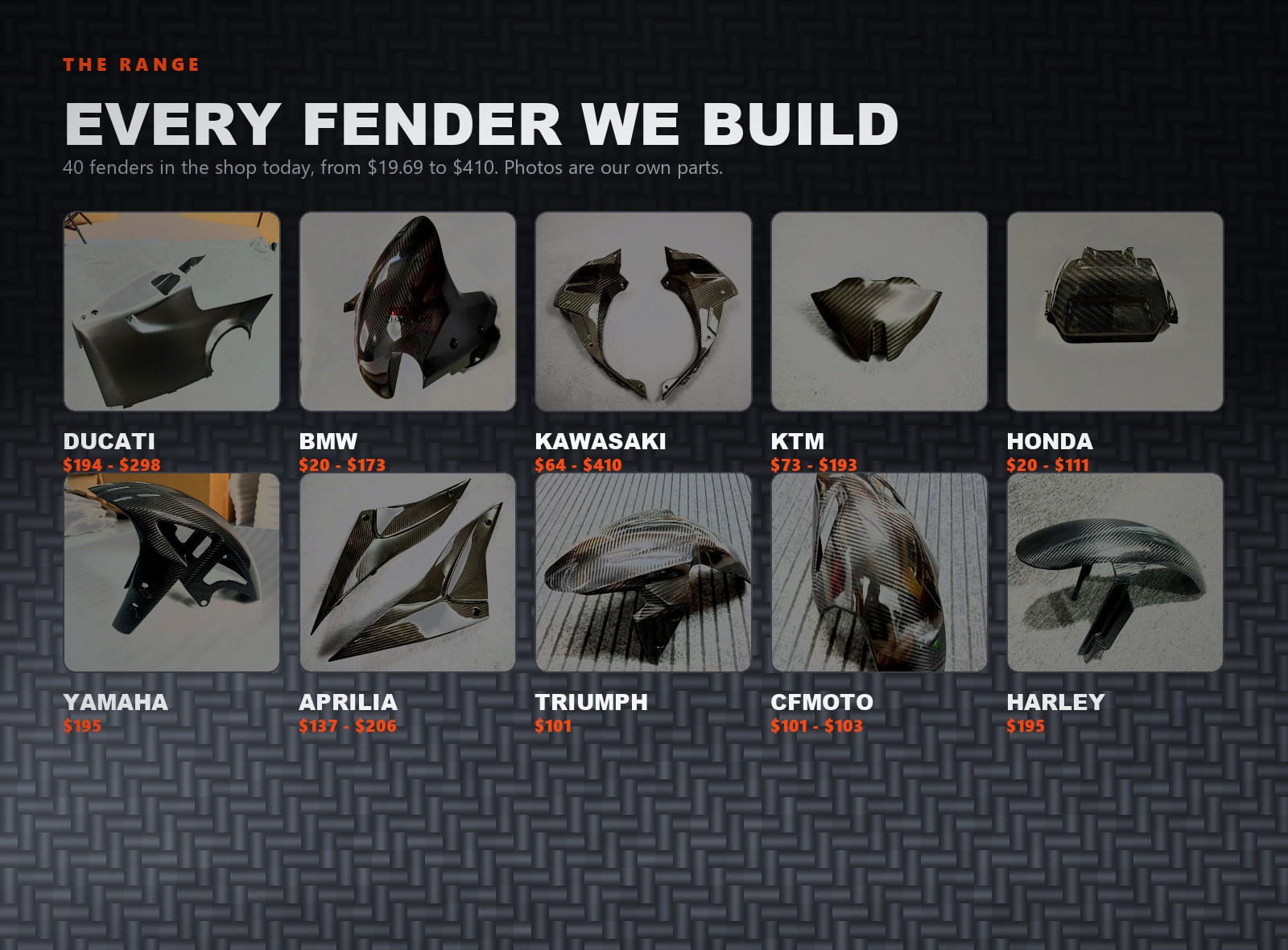
- KawasakiFourteen panels – the widest coverage we have, from the Ninja 400 to the Z900 and the Versys 650.$64 – $410
- DucatiFour front fenders, including a 2025 fitment and the Streetfighter / Panigale V2, V4, V4S and V4R.$194 – $298
- KTMFive panels across the 390, 790 and 1290, in K20 and K22 fitments.$73 – $193
- HondaFour – CB1000R, CBR650R and CB650R, CBR1000RR-R, plus the NS125GU inner fender.$19.69 – $111
- BMWS1000RR and M1000RR front fenders, the 2020 S1000RR, and the F900R / F900XR extender.$19.90 – $173
- ApriliaA front fender and an RS660 rear, both shaped off the original panel.$137 – $206
- YamahaOne fender covering the R1, R6 and MT-10 – the same panel fits all three.$195
- TriumphA rear hugger for the 765.$101
- CFMOTOFront and rear for the 450.$101 – $103
- Harley-DavidsonA front fender for the Low Rider S and ST that re-uses the factory bolts and clips.$195
Two of the forty are listed without a brand name – a rear fender for a “Motorcycle 450” and one for a “Motorcycle 600”. Those exist because the same mould covers several bikes in that class. If you are not sure which one you have, send us photos of the original panel and we will tell you before you order anything.
| Item | What to expect |
|---|---|
| Tools needed | A stand and sockets. A few models are easier with the wheel out. Nothing is cut, drilled or welded – the original fixings are re-used. |
| Time on the bike | 15 to 20 minutes on a front fender. Budget 90 to 120 minutes where you are stripping the tail or fitting a two-piece rear set. |
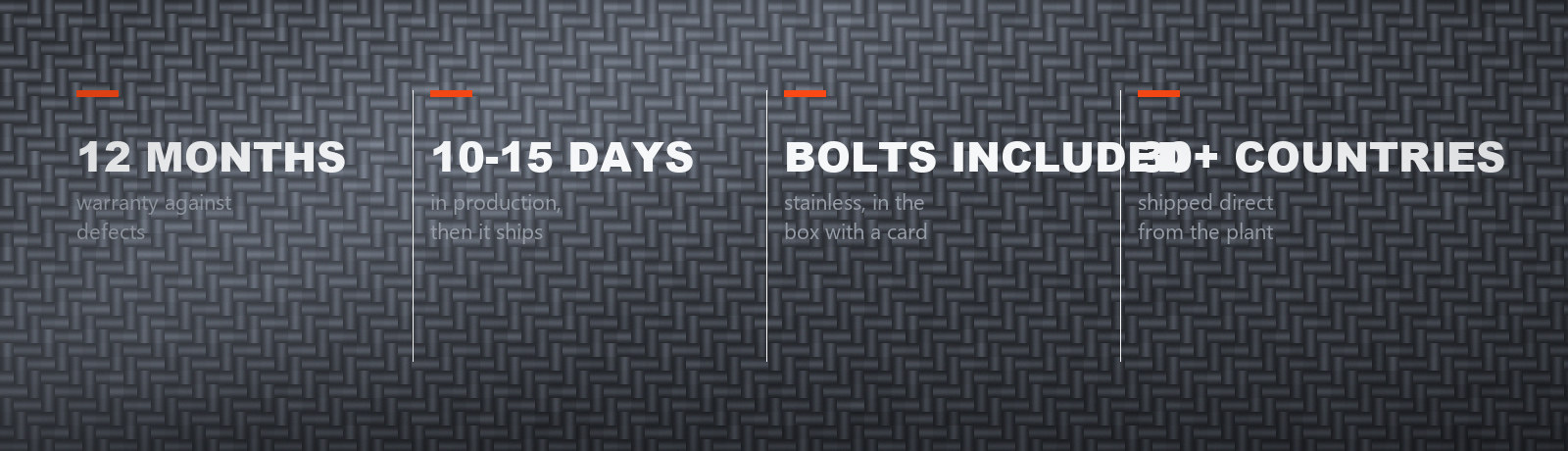
| In the box | The panel, stainless bolts and a fitting card. |
| Production | 10 to 15 business days, because the part is made after you order it rather than pulled off a shelf. |
| Shipping | DHL, UPS and FedEx with tracking, direct from the plant. We ship to more than thirty countries. |
| Warranty | 12 months against manufacturing defects. |
| Check first | Tyre clearance, if you run a wider front tyre than standard. |
| Care | A soft mitt and pH-neutral shampoo. Skip the abrasive polish – it cuts through the clear coat. A ceramic or wax coat once a season is plenty. |
One thing worth saying about quality control
Every panel is visually inspected and test-fitted on the master jig before it is packed. Anything with a lifted clear coat or a distorted mounting edge is rejected rather than shipped at a discount. Because the autoclave curve is logged, a part that does fail can be traced to the batch it came from – which matters more on a fender than on a trim piece, since the bolts are the only thing holding it over a spinning wheel.